Friday, May 20, 2011

Count Your Carbs (cont2)

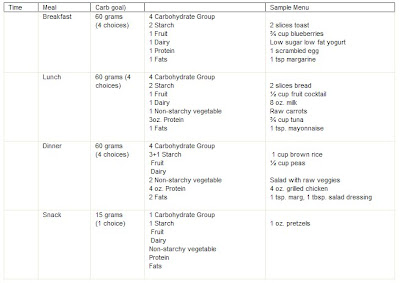
Using Carb Choice to Meal Plan - How This Works

Sample Meal Plan: 1,800 calories 206 gram Carb, 60 grams Fat, 112 gm Protein (45%-30%-25%)

3 meals= 60 grams carbs; one snack 15 grams carbs

1,800 calorie food Exchange Plan

3 Milk, 4 Veg, 2 Fruit, 8 Starches, 8 Meat, 4 Fat - 13 carb choices

Distribute the 13 carb choices evenly throughout the day. A choice can be a milk, a starch or a fruit. So, if you happen to not have enough fruit (15 grams) in a day, you can switch a fruit choice for a starch (15 grams) choice (hopefully it has fiber!).

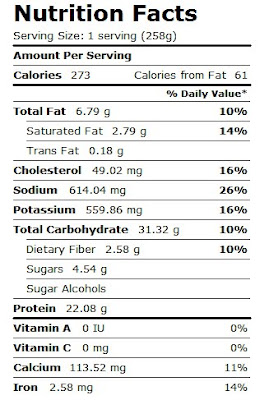
Using the Food Label to Carb Count

Suppose you are eating a frozen dinner meal, or a combination meal of fish, pasta and vegetables. You can use the food label to find the carbohydrate content. Find the total carbohydrates (in one serving or the entire meal - see sample nutrition label below). Fiber and sugars and sugar alcohols are sub-listed there also. If there is more than 5 grams of fiber, subtract half the fiber from the total carbohydrates. This is your amount of carb grams. Divide this number by 15 grams to find the number of carb choices you are using for this food item.

Articles extract from: http://www.diabetescare.net/management_detail.asp?id=1239

Count Your Carbs (cont1)

What is Glycemic Load?

Glycemic Index (GI) and Glycemic Load (GL) are terms you might here about carbohydrate foods. “Glycemic” means “sugar in the blood.” The GI and GL rank carbohydrates on a scale based on their immediate effect on the blood sugar after eating. This is called the glycemic response. Foods with a high GI/GL are rapidly digested and absorbed, raising the blood sugar quickly and high. A slower more gradual rise is preferred.

Sugar, sweets and most refined foods have high glycemic loads. Some surprises, such as cereals and potatoes, also have relatively higher GI-GL. However, when you eat these foods with milk containing protein or a potato with butter and steak and broccoli, the GI-GL changes. Also, the cooking method and food particle size can alter the values. So, GI-GL is a source of controversy because this method is not predictably consistent. It can shed light on why your blood glucose goes so high at times.

Understanding the Food Groups, or Exchange Lists

The
American Dietetic Association, in collaboration with other health associations, created The Exchange System. This system was designed to make meal planning easier for people with diabetes and offer health educators a common and consistent way to instruct them. Foods are categorized together into six groups that are commonly alike - like all fruits - and portions into amounts that are the same composition. For example, all the servings of fruit are 60 calories and 15 grams of carbohydrate. So, each fruit can be “exchanged” for another and the amount of calories and carbohydrate consumed remains the same.

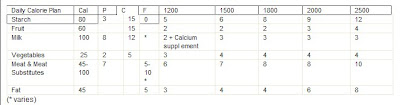
One serving in any group is an exchange. So, your meal plan will designate how many exchanges from each group you should eat. Here are some examples of common meals plans:


(Disclaimer: This chart provides possible meals plans based on about 20-25% Protein, 45% Carbohydrate and 30% Fat. Your dietitian may calculate your meal plan differently based on your food preferences, weight goals and diabetes management. )

Using Carbohydrate “Choices” to Carb Count

Carbohydrate counting is a useful tool to plan your meals, especially to balance with your diabetes medication and insulin. A carbohydrate “choice” is a portion of food that has 15 grams of carbohydrate.

The fruit group, the starch group, and the milk group all have 15 grams of carbohydrate per portion as described. So, if you are planning on having 45 grams of carbs at lunch, you could have one serving of milk, one serving of fruit and one serving of starch. Another 45 gram example for lunch - two starches (30 grams) and one fruit (15 grams).

1 carbohydrate choice=15 grams of carbohydrate

Samples of one carb choice or 15 grams of carbohydrates:
½ cup oatmeal
1 slice of bread
½ English muffin
1 6-inch tortilla
4-6 crackers
½ cup peas
½ cup potatoes
1/3 cup rice or pasta
1 8oz. glass skim milk
2 small cookies
1 medium apple
¾ cup blueberries
1/2 grapefruit

Count Your Carbs (cont)

Traditionally, diabetic diets are designed to start with this calorie distribution:

Protein: 15-25%
Carbohydrate: 40-55%
Fat: 25-35%

Based on your personal health, lifestyle and diet goals, you dietitian can calculate and educate you on the best diet design for you. Your dietitian will take into account your
cholesterol levels, A1C, blood glucose patterns, kidney function, blood pressure, work and sleep habits, meal and snack patterns, and food likes and dislikes to create your unique meal plan.

Sample Calorie Distributions


Based on different calorie levels, you may be allowed from 120 gms to 330 grams of carbohydrate.

The amount of carbohydrate for each person varies with their calorie goals, exercise levels, blood glucose levels and male/female. A healthy diabetic meal plan includes:

Women : 45-60 grams of carbohydrate per meal (3-4 carb choices/meal)
Men: 60-75 grams per meal (4 to 5 carb choices/meal)
For snacks: 15-30 grams of carbohydrate per snack (1-2 carb choices/snack)

Here is a typical example:

1,500 calories - daily total carbohydrates 170 gm (45%). 40 grams (3 meals), 15 gram (3 snacks
)

Count Your Carbs

By now you know that carbohydrates affect your blood glucose levels. No, you do not have to avoid all sweets and starches, and yes, you can have fruit, carrots, and even sugar (in limited amounts)! You need to have a good understanding of what foods have carbohydrates, pay attention to the amount or portion size, select the healthiest carbohydrate foods that offer some fiber, and distribute your “carbs” evenly throughout the day.

What foods have carbohydrates?
- Grains : bread, crackers, rice, cereals, pretzels, pasta
- Starchy Vegetables : potatoes, peas, corn, legumes
- Fruit and fruit juices
- Milk and yogurt
- Sweets and desserts
- Non-starchy vegetables: broccoli, tomatoes, spinach, carrots etc., contain small amount s of carbohydrates and tend to not affect blood glucose unless large quantities are consumed.

The fiber and water content render the small amount of carbohydrate in these foods less available to impact blood glucose.

What are the best carbohydrate choices?

Various forms of carbohydrate affect your blood sugar differently. The same amount of carbohydrate from different foods will have a different effect on your blood sugar. A slice of white bread will raise blood sugar faster than one slice of whole grain bread. In this case, the difference is the fiber content. Foods that digest slowly will relase carbohydrate in the form of glucose into the blood stream more slowly.

Your goal is to eat carbohydrates in such a way that the foods cause a slow, steady release of glucose into your blood stream, so your body can effectively process it. Listed are some factors to keep in mind:
- Carbohydrate foods with fiber will slow digestion and release of glucose; Soluble fiber is particularly favored, such as oat bran, dried beans and peas, fruits, vegetables.
- The more refined the food, the faster the blood sugar rises. Even though fruit juice is healthy, because it is liquid and not solid like the fruit, the quicker the blood sugar will rise. Raw foods tend to be more slowly digested.
- Concentrated sweets such as simple sugar, will quickly raise blood sugar.
- Eating a carbohydrate food with fat, such as butter on the potato, will slow blood sugar rise.
- Adding protein will also slow the digestion - Have peanut butter with some crackers. This is called a combination snack (combines protein, fat and carb)

How much carbohydrate should I have?

There is no official perfect diet for diabetes. The best diabetic diet for you is one that keeps your blood glucose levels as close to target as possible, with the healthiest food choices. There are recommendations from low carbohydrate diets to the Mediterranean diet to vegetarian diets - you can create a personalized diet plan with your dietitian or certified diabetes educator.

Diabetes Management: Diet & Nutrition

Food and Blood Glucose

Eating causes glucose in your blood to go up. How much it increases depends on what you eat (such as how many carbohydrates your food contains) and how much you consume.

Depending on the type of carbohydrate you eat, it can take shorter or longer to digest. The time it takes for food to pass through your stomach - "gastric emptying" in medical terms - affects the amount of glucose in your blood at any one time.

The amount of food you eat also plays a large part in your
blood glucose levels. Too much food, or too many carbohydrates, can cause high blood glucose. Too little food or carbohydrates can cause low blood sugar.

Also, how much and what you eat affects the need for
insulin in your body. The ability for insulin to lower blood sugar plays such a key role that the Food and Drug Administration (FDA) says eating marks the cornerstone of diabetes treatment.

How Much and What Foods are Right?
Many people with diabetes follow an eating plan, but no single plan is right for everyone. Your personal plan will depend on your lifestyle and individual preferences.

The
American Diabetes Association recommends that people with diabetes follow these general guidelines:

* Eat carbohydrates from fruits, vegetables, whole grains, legumes and low-
fat milk.
* Eat fiber-rich foods.
* Keep saturated fats to less than 7% of total caloric intake.
* Eat at least two servings of non-fried fish per week.
* Limit trans fats.
* Restrict
cholesterol intake to less than 200 mg/day.

You’re in Charge
Do not get discouraged just because you need to think carefully about your food choices. For example, living with diabetes does not mean you can never eat foods with
sugar however, you do need to make some changes to live as healthy as possible.

Articles extract from: http://www.diabetescare.net/management.asp?category=Diet

Health: Attack on nervous system

It is possible for multiple sclerosis patients to lead normal lives, discovers SUSHMA VEERA.

ALTHOUGH she had heard of the idiom, don’t judge a book by its cover, Nazatul Aqmar Nazri never gave it much thought until two years ago.

Nazatul, who worked as a chef in Bahrain at the time, felt a numbness on her left side while waiting in a queue to order her food.

She felt dizzy. Her gait was unsteady and her vision was blurring. The police, who did not know that she was suffering from multiple sclerosis, almost arrested the 25-year-old for drunk and disorderly behaviour. “Although I wasn’t locked up, I was traumatised by having to wait six hours before a policewoman attended to me,” says Nazatul.

She was allowed to go home only after a breathalyzer test showed negative for alcohol.

“Each time I recall the incident, I remember the phrase that I learnt in school. If you see someone acting in a strange way, do not judge that person immediately. They could be ill.” Nazatul first suffered from symptoms of multiple sclerosis when she was 14. However, she only underwent tests when she was in Bahrain. “I was admitted and diagnosed with the disease,” she says.

Farah Diana Mohd Amin has also been suffering from multiple sclerosis since her teenage years. “I feel weak and I tire easily. If I walk too much, my legs become swollen,” says Farah, who runs an online boutique.

The attacks became more frequent after her first child was born. She used to get one attack a year but it escalated to four.

“At first I was upset over my condition but I have now accepted it. But my heart breaks each time my 19-month-old son cries. I can only sit and watch. I am afraid to carry him for fear that my hands will become numb and I will drop him,” says Farah, 25. “I will only pick him up if my husband is beside me.” According to consultant neurologist Dr Joyce Pauline Joseph, multiple sclerosis affects the central nervous system, causing the body’s immune system to destroy a substance called myelin.

“Myelin serves as a nerve insulator and helps the transmission of nerve signals. When myelin is damaged, communication between the brain and other parts of the body is interrupted.” Dr Joyce says early symptoms of myelin breakdown include fatigue, dimness of vision, forgetfulness or difficulty concentrating, weakness in the legs, numbness or tingling in the face, arms and legs as well as numbness in the chest and abdomen.

“The symptoms vary widely, depending on the location of affected nerve fibres,” she says, adding that the cause of the disease is unknown.

Dr Joyce was speaking at the recent launch of the A Wake Of Hope campaign organised by the Multiple Sclerosis Society Malaysia. The five-week campaign is aimed at creating awareness of the disease. Also present at the launch was consultant neurologist Dr Shanti Viswanathan who advised patients to consult their doctors regularly and to update themselves on the disease.

“It usually affects those aged 20-40. Women are twice as likely to develop it as men,” she says.

According to Dr Joyce, the disease is common among Caucasians and those living in the Northern or Southern latitudes.

“These people are less exposed to sunlight, which increases the probability of having the disease. There seems to be a link between multiple sclerosis and Vitamin D metabolism.” Both doctors say there is a need to dispel the misconception that multiple sclerosis only happens in Western countries.

“Many think we are not susceptible to the disease, not realising that there are 500-600 multiple sclerosis patients here.

“Diagnosis is often done through blood tests, spinal tap (lumbar puncture), visual tests or Magnetic Resonance Imaging which will show white spots on a patient’s brain and spine,” says Dr Joyce.

There is no cure for multiple sclerosis. Besides oral drugs and steroids, treatment typically focuses on strategies to treat symptoms, which can slow the progression of the disease. “Although it is a life changing disease, with proper treatment and support, patients can lead a normal life,” adds Dr Joyce.

Main symptoms

* Numbness or weakness in one or more limbs, which typically occurs on one side of the body or the bottom half of the body

* Partial or complete loss of vision, usually in one eye at a time, often with pain during eye movement (optic neuritis)

* Double vision or blurring of vision

* Tingling or pain in parts of your body

* Electric-shock sensations that occur with certain head movements

* Tremor, lack of coordination or unsteady gait

* Fatigue l Dizziness